Why launch costs dropped but may not keep dropping
In a study published in PNAS Nexus on July 14, two researchers affiliated with institutes in France, Italy, and the UK analysed more than 4,400 launches in 16 geographical entities and with 330 rocket configurations to find that every time the cumulative payload sent to orbit has doubled since 1960, the average cost of sending 1 kg of payload to low-Earth orbit has dropped by 21.2% and that this correlation outperforms the effects of other technologies on the kilogram cost to orbit. Specifically, the cost has dropped from $87,023 per kg in 1960 to $3,878 per kg in 2025. They also identified a particular inflection point in 2010, when the SpaceX Falcon 9 entered operations.
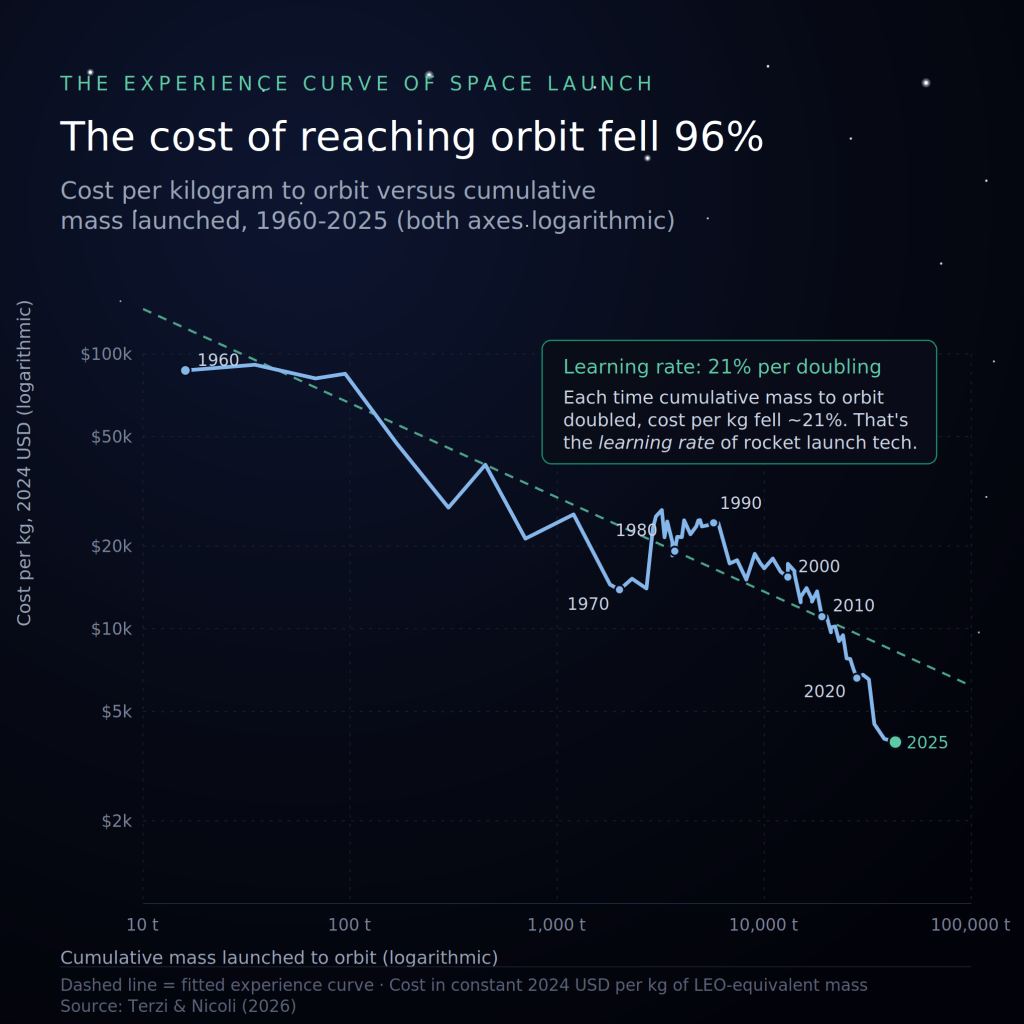
According to the researchers, the fixed drop in cost with doubling of payload mass is called Wright’s law — and if the relationship continues to hold, they projected the launch cost to drop to $1,600 per kg by 2030 and even $300 per kg by 2040. These numbers sound phenomenal, so much so that the researchers also said they could pave the way for, “for instance, microgravity manufacturing for high-quality fiber cables or pharmaceuticals. This in turn would amplify the direct contribution of space to economic growth, going beyond the indirect innovation channel that has been quantified for space or past programs like the Apollo missions.”
But perhaps the numbers are too good to be true. I could spot at least five issues that I think complicate the relationship between the researchers’ more immediate findings and the future projection based on past trends.
First, the researchers have defined their input data such that it includes manufacturing and recurring engineering costs — but it excludes R&D. And R&D costs are an important reason why the ‘true’ cost of a launch has always been somewhat difficult to estimate. Sure, it’s easier for government programmes like the NASA Space Shuttle or the ISRO PSLV, where the true or total cost comes down to the total budget appropriation divided by the number of launches. But for the likes of SpaceX or, now, Skyroot, we only have the prices charged to customers to work with. Also, as the researchers have acknowledged in their paper, a monopolist whose goal is to maximise its profit also has the incentive to keep its prices even if its costs fall. SpaceX, which ferries 75% of all payload by mass to low-earth orbit today, almost certainly does this because it has no real competition. On the other hand, a government might subsidise launch costs on a publicly owned rocket in order to gain market share. So in the former case, the cost curve will appear flatter than the technological learning curve and in the latter, it will be steeper. And overall the curve has the shape it actually does not as a natural consequence of some unalloyed relationship it has with the number of launches or the payload mass.
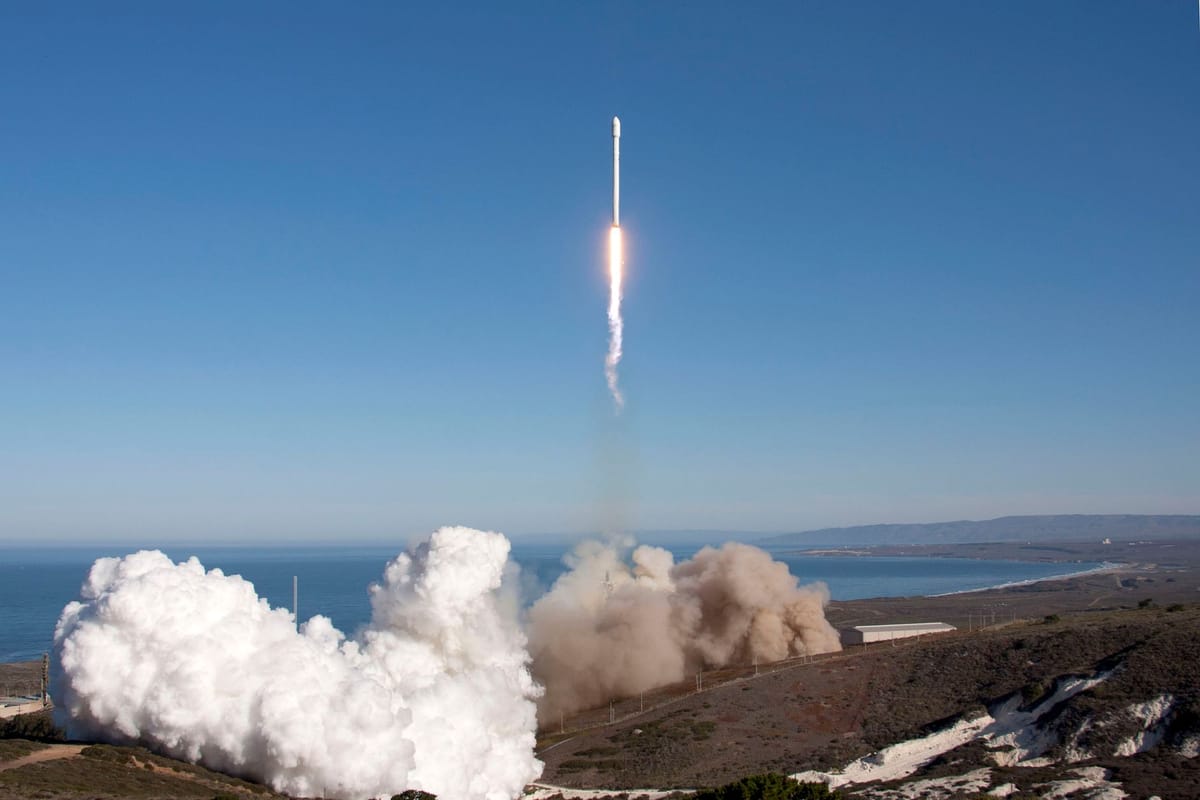
Second, Wright’s law was historically based on aircraft assembly, where each worker could perform a specific task faster as they repeated it over and over, and thus assemblies became more cost-effective over time. However, rockets — especially in the post-Cold-War era and more so since 2010 — have been becoming more cost-effective due to ‘discontinuous’ improvements like reusable stages. In fact, given the disproportionate impact of Falcon 9 missions on launch numbers and payload costs, the log-linear curve the researchers have used to represent what they have argued are the effects of “learning by doing” on the kilogram-cost to orbit misrepresents what was really a singular burst of innovation that probably suddenly and tangibly bent the curve. That in turn would call into question the way the curve is expected to ‘move’ in future.
Third, and in the same vein, the researchers’ projections for 2030 and 2040 are based on the continued success of SpaceX more than another entity in the data. In other words, if SpaceX were to suffer a catastrophic failure or a change in its corporate leadership, the curve’s slope (rate of change) could revert to its value before 2010. As well, the paper could be mistaken in treating the experience curve as a property of launch technologies when it may just reflect the effects of one company’s work culture, and before extrapolating it the researchers should separate the contributions of SpaceX from those of the sector as a whole.
Fourth, Wright’s law essentially offers a way to make sense of the supply based on the demand. So to attain the projected cost of $300 per kg to low-Earth orbit, the researchers’ model requires a large increase in the cumulative payload mass — but will that come to pass? Consternation is already growing worldwide over the number of satellites in Earth orbit, with SpaceX and Amazon planning several thousands more, and the spectre of Kessler syndrome looms large. While orbital regulations failing to materialise altogether or catching up too late are sadly plausible, there is reason to expect low-Earth orbit in particular will become too congested and/or dangerous to populate further. That in turn would throttle demand and cause cumulative payload mass to double only once every few decades.
Finally, is ‘dollars per kg’ itself a good metric? It’s the industry standard for high-level analyses, such as benchmarking the cost-efficiency of national launchers, but it wasn’t intended to facilitate understanding of the qualitative differences between rockets — which are relevant for the study’s analysis. For example, economically speaking, a ‘cheap’ rocket with a 90% success rate will be more expensive than a rocket with a 100% success rate when the payload is worth hundreds of millions of dollars. Similarly, different rockets subject their payloads to different forces and stresses. So a rocket with a lower cost to orbit might require a satellite to be built like a tank, but this wouldn’t represent a real drop in the cost to access space. The metric also doesn’t account for last-mile delivery. A Falcon Heavy can transport several dozen satellites to one particular low-Earth orbit for a lower cost, while leaving them to figure out how they can get from there to their intended final orbits (with their own propulsion). On other hand, customers might pay a slightly higher fee to ISRO or Skyroot for a ride onboard the SSLV or the Vikram-1, in return for the rocket dropping satellites off closer to or at their destination itself (freeing the satellites from including propulsion). But by rolling all these differences into a single ‘dollars per kg’ figure, the researchers may be oversimplifying the market itself: the falling cost might be truer for ‘bulk commodities’ like Starlink satellites but not for significantly more valuable scientific missions, like space telescopes, and other commercial missions like communications satellites.
Taken together, the study may provide a good macroscopic view of the space economy and reveal how one important degree of freedom — cost per kg to low-earth orbit — is changing as the enterprise becomes increasingly industrial in character. At the same time, the enterprise isn’t a factory per se but a highly concentrated and technologically volatile arena sensitive to radical advances in engineering and single-point failures, and which thus defies how much its history can say about its future, at least at this time.