Gyroscopes

As silly as it sounds, as a student of mechanical engineering, I am partial to technologies that make use of mechanical forces. Today they are harder to come by because the solutions to the problems they solved were replaced by electronic components from the mid-20th century on. Today, newer technologies based on quantum physics are beginning to displace electronic devices, at least in specific use cases.
In the landscape of electronic technologies, microelectromechanical systems (MEMS) are among a few honorable exceptions. As the name indicates, these technologies combine both electronic and mechanical components to solve specific problems.
And among them, a tool called a gyroscope has been particularly fascinating: both mechanical and MEMS versions coexist today depending on the setting. And even though scientists and engineers are devising newer ways move beyond them to even more advanced forms, they are also finding ways to significantly improve the existing ones.
Recently, scientists from China and Japan reported in Nature that they had found a way to boost the sensitivity of chip-based gyroscopes by three orders of magnitude.
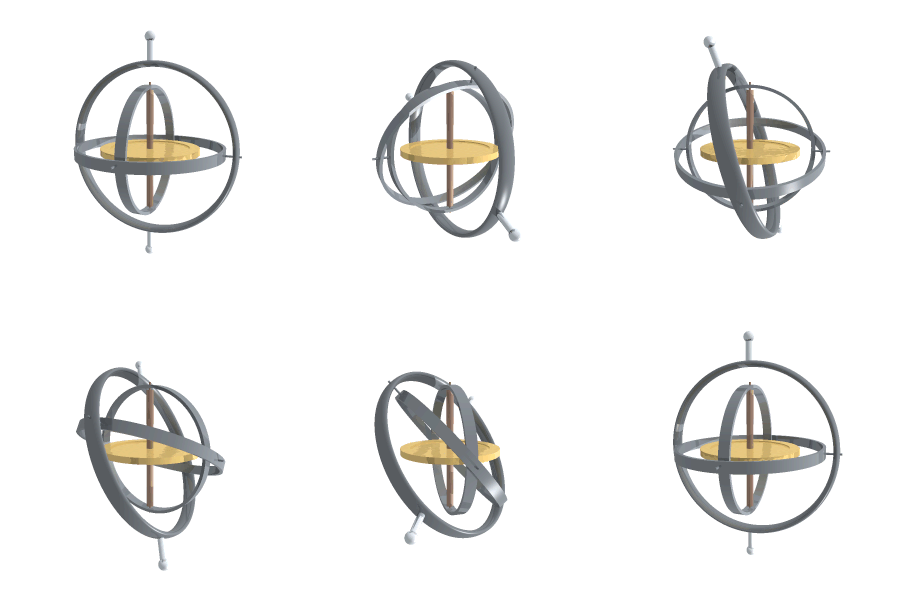
If you rapidly spin a large wheel and then try to change its axis, the wheel will resist. This is the working principle of a gyroscope, a device used to determine the orientation of the container it is fixed in. For example, ships use gyroscopes to know which way they are pointing and satellites use gyroscopes to alert their computers to when they start to drift from their intended orbit.
As the wheel spins and you try to change its axis of rotation, it will respond by moving in a new direction that is perpendicular to the direction of change and to its original axis. The wheel is said to experience the Coriolis force and physicists call this phenomenon gyroscopic precession.
A computer can use it to figure out the object’s orientation and, if necessary, which way the change is arising and counteract it.
These days, your smartphone has a gyroscope, too, but it works slightly differently. For starters, it is microscopic. There is a tuning fork that a small battery vibrates at a fixed frequency. When you rotate the phone, the axis of vibrations will change. The fork will resist this with gyroscopic precession: it will curve ever so slightly.
This setup is placed between two parallel plates, forming a capacitor. The plates are connected to each other via a circuit. When the fork curves, the voltage between the plates will change, which a circuit component will measure and relay to the computer. Finally, the computer will use this signal to determine the change in orientation.
Because this gyroscope design is so small and involves both electrical and mechanical components to work, it is an example of a MEMS technology.
It is not perfect because no sensors are perfect. For example, if the gyroscope is off by just 0.05° per second, after 20 seconds the orientation reading will be off by 1°. This is called drift — and a computer can correct for it by also using readings from an accelerometer (which sense gravity to say which way ‘down’ is) and a magnetometer (it can say which way north is, among other readings).
MEMS gyroscopes exist in an engineering sweet spot. They are an example of miniaturisation in electronics but because its components involve mechanical forces as well, shrinking them even further is nearly impossible. Rather, you can’t shrink them without significantly degrading their performance.
A larger gyroscope is heavier, so its moving part is harder to rotate or vibrate. But they are also much more precise than MEMS gyroscopes and are thus used onboard ships and satellites. On the other hand, it is infeasible to have a sufficiently large rotating object inside a smartphone.
But because the extent of gyroscopic precession depends on the mass of the tuning fork, beyond a point it becomes too weak to measure. Similarly, the signal from the capacitor becomes too faint if the moving structure has less area, and smartphone gyroscopes these days are already dealing with a few attofarads.
(1 attofarad is 10-16% of 1 farad. Put another way, if 1 farad is all the water in an Olympic swimming pool, 1 attofarad is the amount of water in a single human cell.)
Second, if you make the fork too small, the thermal energy of its atoms will start to dominate its motion, setting it vibrating randomly due to very small changes in temperature. MEMS gyroscopes are thus usually tens to hundreds of micrometres wide because the competing forces balance out at this scale.
Of course, there are many applications (or certainly valuable ones) that are still looking for smaller gyroscopes that are also more precise. So engineers have switched the technology platform — from MEMS to optomechanical systems that measure changes in direction based on changes in a light signal, atomic gyroscopes that use the wave nature of atoms, and of course emerging opportunities based on quantum physics.
But in the new Nature study, the scientists made the gyroscope’s output frequency up to 1,010-times more sensitive to the Coriolis force. This translated to a 253-fold improvement in the signal-to-noise ratio and a 297-fold improvement in the measurement precision.
In a MEMS gyroscope, the tuning fork can vibrate in two ways: one when it is set vibrating by the setup and the other when the smartphone rotates and the Coriolis force is acting on the fork.
Let’s say in the first instance, the fork vibrates left-right and in the second, top-down. These two modes are independent: when it is vibrating left-right, it does not also vibrate top-down unless it is forced to. When you rotate your phone, the Coriolis force applies this force, causing the fork to vibrate in a mix of the two modes and the capacitor measures the extent of that mix.
In the study, in a MEMS gyroscope, the scientists coupled the two modes in a variable way so that the usual amount of Coriolis force produced an extraordinarily large change in the frequency of vibrations.
Because this way did not amplify the Coriolis force itself, only one part of the fork’s response got amplified; the noise did not. If a rotation normally changed the resonator’s frequency by 0.01 Hz, now it could change by 10.1 Hz. Thus, the authors wrote:
For the first time to our knowledge, we have demonstrated how to generate ultrasensitive responses with sublinear scaling of the Coriolis effect… [This advances] the previous understanding that the CVG [Coriolis vibratory gyroscope] output is always proportional to the rotation input. Through this singular Coriolis effect, we have broken the physical limit of the CVG sensitivity imposed by the intrinsic Coriolis factor. We have shown that this discovery can lead to large improvements in sensitivity, precision and signal-to-noise ratio of a CVG. Our findings open up fundamentally new avenues to regulating CVGs and other systems involving the Coriolis effect.”
And so, a mechanical technology lives on.